
Reading Notes
Against Purity and Fear of a Dead White Planet

Dear Readers,
Two books I am currently reading.
Against Purity (Alexis Shotwell, 2016)
Shotwell’s argument is that purity is not just a way to describe matter or a certain condition. It is highly entangled with politics and history. Purism, as Shotwell argues, is a common way to undertstand the wolrd but problematic because response needs dichotomies and notions that are not stable.

From page 15:
To be against purity is, again, not to be for pollution, harm, sickness, or premature death. It is to be against the rhetorical or conceptual attempt to delineate and delimit the world into something separable, disentangled, and homogenous. With and following María Lugones, I am “firmly planted against the logic of boundedness.” I follow her argument “for intercommunalism from the midst of impure subjects, negotiating life transgressing the categorical understandings of a logic of binaries that produces hard- edged, ossified, exclusive groups” (Lugones 2003, 35). Lugones critiques a meta-physics of purity, understood as separability, fragmentation, and standing outside culture and situatedness. The Man of purity, as a figure, “shuns mpurity, ambiguity, multiplicity as they threaten his own fiction. The enormity of the threat keeps him from understanding it. So, the lover of purity remains ignorant of his own impurity, and thus the threat of all impurity remains significantly uncontaminated” (132). The metaphysics of purity is necessarily a fragile fiction, a conceit under constant but disavowed threat to affirm a commitment to purity is in one move to glance at the entanglement and coconstitution, the impurity, of everything and to pretend that things are separate and unconnected.
What makes the book useful is that Shotwell traces purity as a product of a particular formulation of modernity. A formulation that has driven colonial projects, genocidal and ecological destruction often framed as acts of cleansing. When purity gets invoked, it tends to be in the service of power: legitimising racism, white supremacy, the violent management of what or who counts as contamination. A pure, uncontaminated state has never existed. All matter and beings are always already entangled.
Fear of a Dead White Planet (More Worlds Collective, 2025)
The title comes from Public Enemy’s Fear of a Black Planet (1990) — and the book carries a dual gesture: diagnosis and activation. The More Worlds Collective resists the contemporary rush toward planetary technofixes for environmental emergency, arguing that the very frames we use to understand crises. Notions like the Anthropocene, global health, GDP are not neutral. They are what the authors call Charismatic Mega Concepts (CMCs): large technical systems that animate only particular worlds into existence while quietly erasing others.
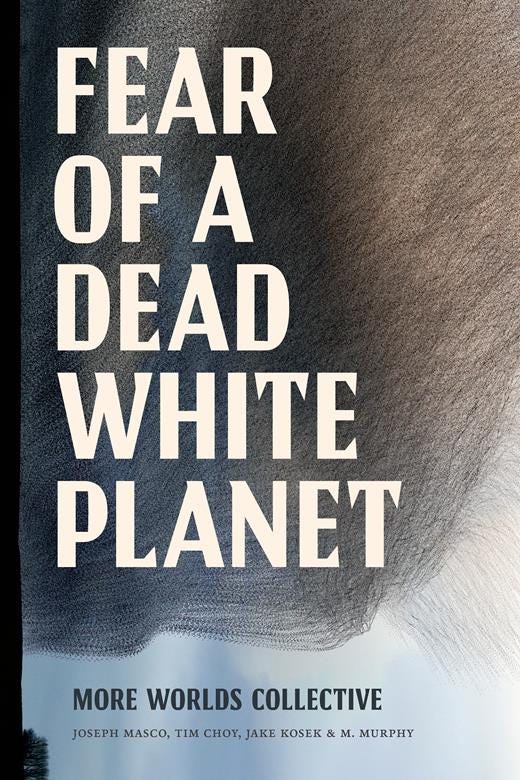
The planetary move (concepts such as one world, one species, one crisis) clears the ground for a particular kind of concept that claims ultimate scale. It eliminates the vast and different ways people actually live, the multiple worlds that coexist in tension, the wildly divergent impacts that communities have on collective conditions. And it does so while offering the feeling of comprehension. Their alternative is not another framework but a practice and research that makes room for hostile worlds even at modest scale.
From page 82: (while looking closely the idea of terraformations)
Understanding complexity is a matter not only of optics and precision; it also reveals what you care about, what is messing with you, what binds you are caught in, what violences need calling out, and how pain matters to the constitution of your study. In this way, we offer resolution not as a term referring to a scale of granularity of data or view, but as an invitation to an ongoing processual method of ethical and political resolve. Resolution as resolve is about inhabiting and obligating to the legacies, politics, movements, communities, and ethics of somewhere. How are you obligated to the specific Indigenous legal order of the land you study on? How are you obligated to defend a terraform? How are you obligated to consent or refusals? How are you joined up with abolition? Such resolve may yield commitments in scale; that is, the scaling of your study or attention: Do you have responsibilities to this tree, this architecture, this taxonomy? How do you fulfill and renew such responsibilities? Resolve in this key makes the question of scales and optics a question of commitments and obligations to people, beings, and forces.
“Study will never be enough” is not sighed in resignation, nor is it thrown like a weapon. It marks the limits of the modes of study that call themselves research and hails others to come.
Both books are asking something similar: how do we act politically, intellectually, collectively but without reaching for the false clarity of clean categories?